Google Search Console: The Busy Beginner's Guide
The only Google tool that tells the truth about your visibility. 10-minute setup, the 3 screens that matter, and how to tell a real problem from a normal number.
What Search Console tells you (and Analytics never will)
Google Search Console is the only free tool that shows you what Google sees of your site. Not what your visitors do once they arrive — that's Analytics. Search Console tells you how many times your site appears in search results, for which queries, at what position, and most importantly: how many times people click. Analytics shows you who came. Search Console shows you who isn't coming yet, and why.
A concrete example. Your site appears 1,200 times a month for "plumber Montpellier", but you only get 18 clicks. You're visible, but in tenth position. People see you, they choose someone else. Analytics won't tell you that. You also discover 200 people search "emergency plumbing repair Montpellier" and your site doesn't appear at all. You just identified a content gap. You write a dedicated page, submit it for indexing, and three months later you capture part of that traffic.
10-minute setup (no code required if you prefer)
You open search.google.com/search-console, log in with a Google account, and declare your site. Google asks you to prove the site is yours. Three methods exist.
Method 1: HTML file. Google gives you a file to download, you place it at your site's root, you click "Verify". If you have file access, it's the fastest. Downside: if the file disappears, you lose access.
Method 2: meta tag. Google gives you a line of code to paste in your site's head section. More durable than the file, but you need to edit the HTML.
Method 3: DNS record. You add a TXT record in your domain's DNS zone. This is the most robust method: it validates the entire domain. Even if you change hosts, access remains.
Once validated, Google starts collecting data. You won't see anything for 24 to 48 hours. Google doesn't backfill history, it starts the counter from now.
The three screens that matter
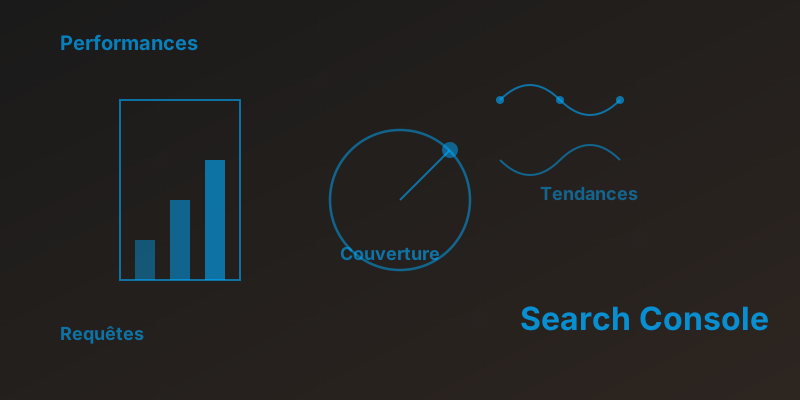
Performance: the queries bringing you traffic
The "Performance" screen lists all queries for which your site appears in Google, with four numbers: impressions, clicks, click-through rate (CTR), and average position. You sort by descending impressions, and you immediately see the queries where you're visible but poorly ranked.
Example: you're an electrician in Sète. You appear 850 times a month for "electrician Sète", average position 8.2, with 22 clicks. Your CTR is 2.6%. That's low. In position 8, you're at the bottom of the first page on desktop, invisible on mobile. Two solutions: improve your position by strengthening content, or rework your title and description to increase CTR.
The screen also shows which pages generate the most impressions. You discover your homepage captures 70% of traffic, while your "Emergency electrical repair" page appears only 12 times monthly. You check in "Coverage" if it's indexed.
Coverage: what Google crawls (and what it ignores)
The "Coverage" screen tells you how many pages Google has indexed, how many are in error, and how many are excluded. A showcase site of 8 pages should show 8 indexed pages. If you see 3, there's a problem. Either the other pages aren't linked from navigation, or they're blocked by robots.txt, or Google hasn't crawled them yet.
Most frequent errors: 404 pages that Google still finds in links, server errors (500), and redirected pages. One or two 404 pages isn't serious. Fifty 404 pages signals you deleted content without setting up 301 redirects.
Excluded pages aren't necessarily a problem. Google excludes by default duplicated pages, empty pages, and pages marked noindex. If you see 150 excluded pages on a 10-page site, you click "Excluded" and discover Google found 140 pagination URLs you didn't want indexed.
Experience: Core Web Vitals and mobile usability
The "Experience" screen measures loading speed and mobile usability. Google classifies each page as "Good", "Needs improvement", or "Poor" according to three metrics: LCP (time before main content display), FID (click responsiveness), and CLS (visual stability).
If 80% of your pages are "Poor", you have a performance problem. It slows your site, and since 2021 it's an official ranking criterion. You test a page in PageSpeed Insights, get the problem list: heavy images, blocking scripts, poorly loaded fonts. You fix, resubmit, and come back three weeks later to verify improvement.
How to tell a real problem from a normal number
Search Console displays raw numbers. The trap is panicking over a number without knowing if it's normal. Here's how to read the three most frequent signals.
1,000 impressions and 10 clicks: is that bad? Depends on position. At average position 12, a 1% CTR is normal. You're on the second page, nobody clicks. At position 3 with 1% CTR, that's abnormal: you should be around 15-20%. The problem isn't your ranking, it's your title or description.
"12 indexed pages, 48 excluded pages": is that a problem? Not necessarily. You look at the details. If they're legal notices or form confirmations, that's intended. If they're content pages, that's a problem.
"3 errors 404": should I fix? Yes, but not urgently. Three not-found pages on a 50-page site isn't critical. If it's an old page you deleted voluntarily, you add a 301 redirect. Fifty 404 errors, however, signals a poorly managed redesign.
What NOT to do with Search Console
First mistake: panicking over daily fluctuations. You see 120 clicks Monday, 45 clicks Tuesday, you think the site dropped. Wrong. Local searches follow your clients' calendar. A plumber gets more searches Monday morning than Thursday afternoon. Look at trends over 28 days minimum.
Second mistake: submitting the URL with every change. You change a word, you click "Request indexing". Useless. Google naturally crawls active sites every week. You submit new pages or urgent fixes, that's all.
Third mistake: ignoring alerts. Search Console sends emails when it detects a problem: 404 spike, non-indexed pages, server errors. You receive the email, say "I'll look later", and forget. You open the email the same day, verify, and fix if real.
Where to start (in order)
You just connected Search Console, here's what you do in order.
- Verify all your important pages are indexed. You open "Coverage", look at the number of indexed pages. You compare with the actual number.
- Identify your three main queries. You open "Performance", sort by descending impressions, note the three queries generating the most displays.
- Test your main pages in PageSpeed Insights. You take the three pages generating the most traffic, test them, note the three most serious problems.
- Fix 404 errors if you have more than ten. For each page, either you add a 301 redirect, or you fix the broken internal link.
- Come back every two weeks. You verify nothing broke, and you track the evolution of your three main queries.
What to remember
- Search Console shows what Analytics doesn't see: queries for which you appear without being clicked, pages Google doesn't index, and errors blocking crawling.
- Setup in three methods: HTML file (fast), meta tag (durable), or DNS (most robust). Data appears 24-48 hours after activation.
- Three screens to monitor: Performance (which queries, what position, what CTR), Coverage (which pages indexed, what errors), and Experience (speed and mobile usability).
- A number alone means nothing: 1,000 impressions and 10 clicks is normal at position 12, abnormal at position 3. Always look at average position before concluding.
- You come back every two weeks, not every day. Search Console detects structural problems and tracks long trends.
Topics covered
Your app monitored, fixed and improved every month, from €129/month.
See the maintenance plansGot a project in mind?
We look at your site together and tell you frankly what can be improved. No commitment, no sales pressure.
More to read
Organic vs Paid Search: Which One for Your Local Business
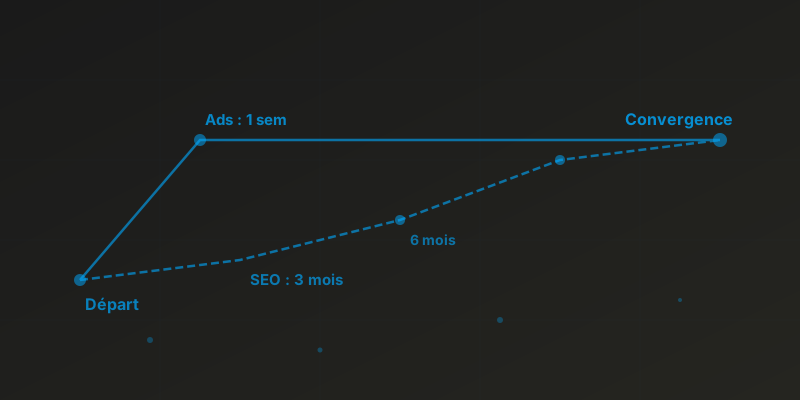
Budget, timeline, cost per lead: the decision matrix to choose between SEO and Google Ads. When not to run paid ads.
Read article
Your site doesn't appear on Google: 7 causes and their fixes
Not indexed, forgotten noindex, recent site, competitive query: the 7 causes of invisibility and how to check each one in two minutes.
Read article