How Many Clients Does a Website Really Bring?
From 23 clicks in 6 months to +137% growth in a year: anonymized Search Console data, real conversion rates, and the 4 factors behind the gap.
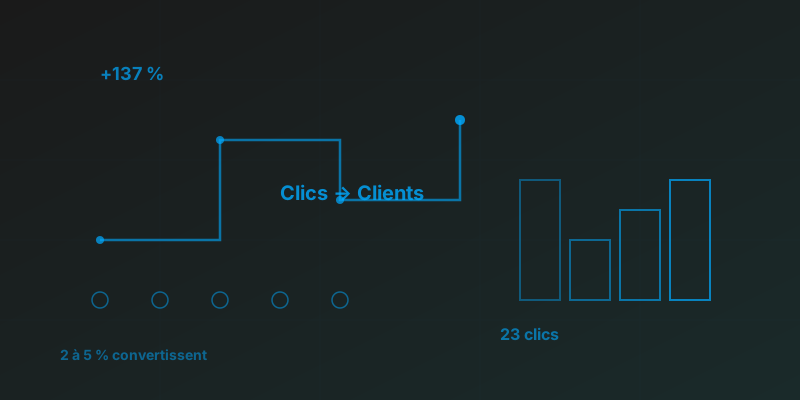
The short answer: from 23 clicks to +137% in one year
The question isn't "how many clients does a website bring," it's "under which conditions does it bring any." Because the numbers we see in our clients' Search Console accounts range from 23 clicks in six months to +137% click growth over a year. The gap isn't a mystery. It comes down to four measurable factors: the trade, local competition, site content, and Google Business Profile status.
A well-ranked local business website generates 50 to 400 organic clicks per month in its first full year. Of those clicks, 2 to 5% turn into contact requests — calls, forms, or direct emails. That's 2 to 5 inquiries per 100 monthly clicks. After that, the inquiry-to-project conversion rate depends entirely on your trade and response time.
From clicks to inquiries: the real arithmetic
Take a site receiving 100 organic clicks per month from Google. That's average performance for a tradesperson or local business in an urban area, six months after launch, with a complete Google Business Profile and three to five content pages.
Out of 100 clicks, you get 2 to 5 contact requests. The rate depends on three things: offer clarity, phone number visibility, and recent Google reviews. A plumber with 20 reviews and a call button at the top converts at 4-5%. A carpenter with no reviews and a form at the bottom runs at 2%.
So 100 clicks = 2 to 5 inquiries. How many become projects? That's on you. An electrician who picks up in one ring and sends a quote the same day converts 50 to 70% of inquiries. An architect who requests a written brief before calling back converts 20 to 30%.
Example: 100 monthly clicks, 3% inquiry rate, 40% inquiry-to-project rate. You get 3 inquiries per month, 1.2 turn into projects. Over a year, that's 14 projects from the site. Compare that to €149/month or €1,190 paid once.
The arithmetic changes when you double traffic. At 200 monthly clicks, same rates, you jump to 6 inquiries and 2.4 projects per month — 29 projects per year. That's why we push local SEO: every traffic doubling doubles projects, at constant sales effort.
What explains the gap between extremes
The 23 clicks in six months? A site launched then abandoned. No Google Business Profile, no content beyond the homepage, sometimes not even a sitemap sent to Google. The site exists, it's technically findable, but no one finds it. The 23 clicks come from brand searches — people typing the business name because they saw it elsewhere.
The +137% growth in a year is the opposite. Complete Google Business Profile from day one, with photos, hours, precise categories, and customer reviews. Six content pages instead of one: one per service, one for service area, one for portfolio. Regular Google Business posts. Updated holiday hours. Review responses within 48 hours.
Between the two, four factors explain the gap: the trade (a plumber gets 10x more local searches than an interior architect), local competition (200 competitors in Montpellier city vs. 12 in Sommières), site content (five specific service pages vs. one generic page), and Google Business Profile (complete with 15 recent reviews vs. empty with two 2022 reviews).
Conditions for a business site to generate inquiries
A site that generates contact requests meets four conditions. You can verify all four in fifteen minutes.
Be findable. Search "your trade + your city" in Google, private browsing. You should appear in the top ten organic results or the Local Pack at the top. If you're not there, no one finds you.
Reassure fast. A visitor arriving at your site opened three other tabs simultaneously. You have ten seconds to convince them to stay. What reassures: Google reviews on the homepage, recent project photos, phone number visible without scrolling. What doesn't: a six-slide carousel, generic text "Your trusted partner," contact form with no other way to reach you.
Match intent. Someone searching "boiler repair Montpellier" wants a plumber who acts fast, not a "General plumbing — All work" page. A dedicated repair page, with intervention hours and direct call button, converts. The generic page doesn't. See how we structure client sites to match each search intent.
Stay current. A site with outdated hours, a Google Business Profile showing "Open" when you're closed, or unanswered reviews from six months ago tells visitors you're not paying attention. They'll call the competitor below you, the one who responded to their last review two days ago.
When a site will bring nothing
There are cases where a business site, even well-built, will generate zero organic inquiries. Better to know before paying.
Trade without local search. A transition management consultant, LBO-specialized accountant, or naval architect will never be found through local Google search. Their clients don't type "transition consultant + city." They come through referrals, LinkedIn, or tenders. A business site serves as a digital brochure to reassure after introduction, not as an acquisition channel.
Area without volume. A tradesperson based in a 400-person village, not serving surrounding towns, will never receive enough searches to generate traffic. Search volumes for "plumber + [400-person village]" are zero. The solution is to expand the service area to 20 or 30 km and specify it on the site and Google Business Profile.
Saturated market without differentiation. If you're the 47th plumber in central Montpellier, same offer, same rates, zero Google reviews, you'll never rank above the other 46 who have five years' seniority and 80 reviews. The site won't be enough.
Site built then abandoned. A site launched without Google Business Profile, without sitemap sent to Search Console, without any content updates, will produce nothing. Google doesn't spontaneously crawl all new sites. You must signal your site's existence, verify it indexes it, and publish content regularly for it to consider it active.
What to remember
- A well-ranked local business site generates 50 to 400 organic clicks per month, 2 to 5% of which become contact requests.
- The gap between 23 clicks in six months and +137% in a year is explained by four factors: trade, local competition, site content, and Google Business Profile.
- Conditions to generate requests: be findable in local search, reassure in ten seconds, match precise intent, stay current.
- A site will bring nothing if the trade has no local search volume, the area is too small, the market is saturated without differentiation, or the site is abandoned after launch.
Want to know what your site already produces, or what it could produce? We look at your current Search Console numbers — or your direct competitors' if you don't have a site yet — and tell you in fifteen minutes what's missing to reach the next level. First diagnostic is free.
Topics covered
A showcase site written for your trade, €149/month all-in.
See our website packagesGot a project in mind?
We look at your site together and tell you frankly what can be improved. No commitment, no sales pressure.
More to read
Google Search Console: The Busy Beginner's Guide
The only Google tool that tells the truth about your visibility. 10-minute setup, the 3 screens that matter, and how to tell a real problem from a normal number.
Read article
Organic vs Paid Search: Which One for Your Local Business
Budget, timeline, cost per lead: the decision matrix to choose between SEO and Google Ads. When not to run paid ads.
Read article